 Back
Back
The Challenge – The gap between research and deployment.
Spectrum scarcity is no longer primarily a physical limitation; it is a systems and coordination problem. While significant spectrum remains under utilised spatially and temporally, the industry lacks the tools, data, and experimental environments required to safely enable large-scale reuse across heterogeneous networks, limiting the ability to improve spectrum efficiency, reduce congestion, and support next-generation wireless services. Existing approaches to address this challenge fall into three broad categories:
- Improving spectrum efficiency within individual systems through techniques such as advanced modulation and coding, MIMO and other antenna innovations, and increasingly complex resource allocation and densification strategies – a strategy that is reaching its limit, with economic restraints.
- The use of new spectrum bands, including mmWave and sub-terahertz frequencies, alongside reframing and clearance strategies – a strategy that is costly, geographically limited or unsuitable for wide-area deployment.
- Spectrum sharing between systems, which targets inter-system efficiency, and offers the potential for order-of-magnitude gains in effective spectrum availability – a strategy that is the most promising. However, progress has been limited by the lack of large-scale experimental validation, restricted access to real spectrum data, uncertainty around safe automated coordination and the capability for coordinated decisions across the communications stack rather than optimisation at a single layer.
As a result, promising concepts in dynamic spectrum access and coexistence often fail to progress beyond simulation or small-scale trials, creating a critical gap between research and deployment.
The Approach – Build an integrated experimental setup.
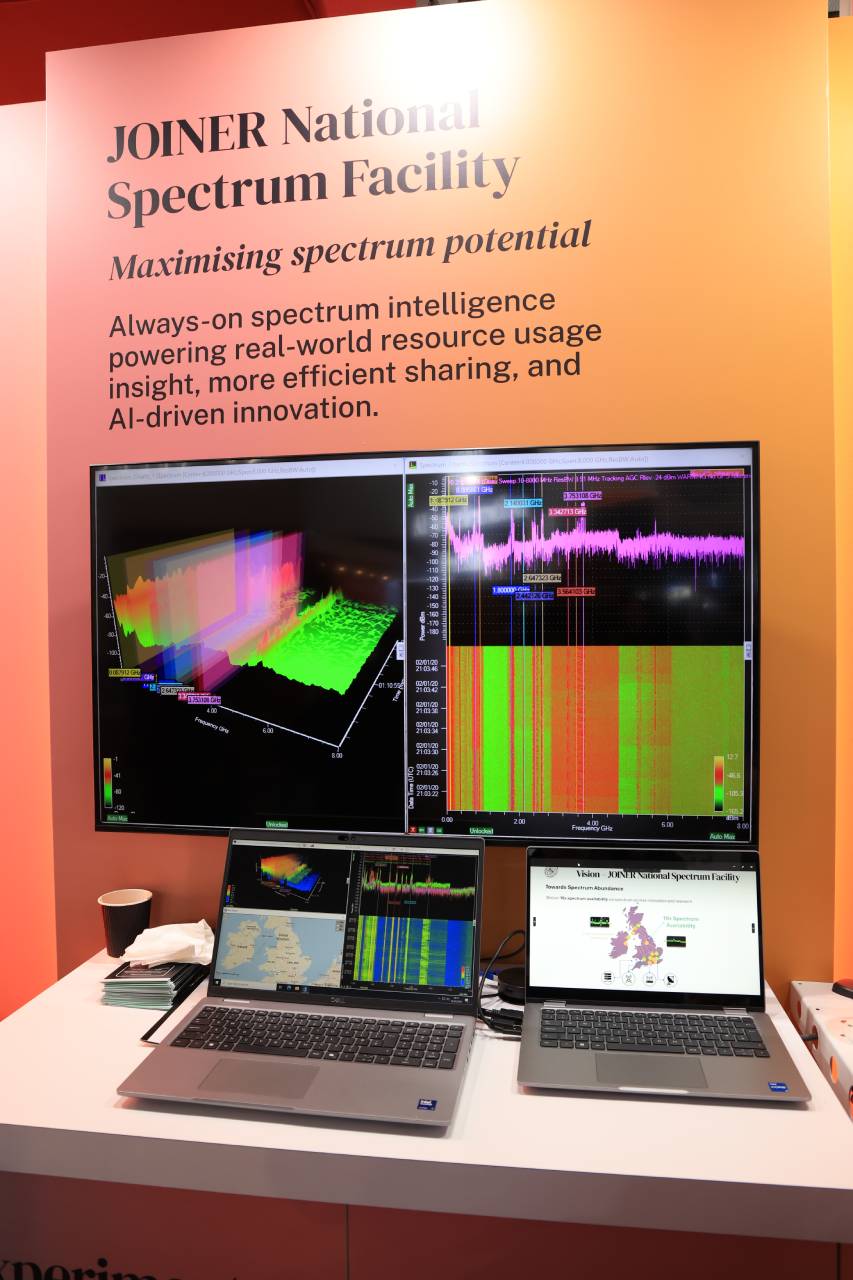
JOINER’s National Spectrum Facility (JNSF) provides a UK-wide, measurement-driven research infrastructure designed to transform spectrum from a constrained and statically allocated resource into a continuously observable and intelligently managed system. At the core of the facility is an integrated experimental setup that combines live spectrum monitoring, controlled emulation environments, and replay-based analysis pipelines. This allows spectrum activity to be captured under real operating conditions, reconstructed in controlled settings, and analysed repeatedly under varying assumptions. Data flows from distributed sensing nodes into a centralised processing environment where it is stored, processed, and made available for both real-time analytics and offline research workflows.
The facility brings together a range of technologies spanning the full wireless stack, including wideband RF sensing systems, software-defined radio platforms, high-throughput data ingestion and storage infrastructure, and AI-enabled signal processing and analytics pipelines. These are complemented by distributed compute resources that support large-scale post-processing and model training, as well as experimental frameworks for automated spectrum assignment and coordination.
Importantly, JOINER enables experimentation across multiple layers of the communications stack, from physical-layer propagation and channel behaviour through to MAC-layer interference management, network-level coordination, and application or policy-driven spectrum allocation. This cross-layer capability is critical for studying spectrum sharing in realistic environments, where behaviour emerges from the interaction of multiple systems rather than isolated
components.
The uniqueness of JOINER lies in its ability to support closed-loop experimentation at scale. Researchers can observe spectrum usage, emulate realistic RF conditions, replay historical activity, and test automated sharing strategies within a single integrated environment. Without this infrastructure, such end-to-end validation of spectrum sharing concepts under realistic conditions would not be feasible.
The Outcomes – Foundation for measurement-driven spectrum research.
JNSF establishes a foundation for measurement-driven spectrum research that directly connects raw RF observations to actionable intelligence for researchers, industry, and regulators. One of the key outputs is a validated experimental framework for studying dynamic and automated spectrum
sharing under realistic and repeatable conditions. This includes the ability to generate and reuse large-scale datasets that capture real spectrum behaviour across different environments and usage scenarios.
The facility also enables the development and demonstration of end-to-end spectrum intelligence workflows, including the ability to monitor, analyse, emulate, and replay spectrum activity within a unified infrastructure.
More broadly, the project is generating foundational datasets and tooling to support the development of AI-driven spectrum management systems, as well as early evidence that intelligent spectrum sharing can significantly increase usable capacity without requiring proportional expansion of allocated spectrum. This creates a pathway for industry to move from static, manually coordinated spectrum use towards adaptive, data-driven, and potentially
autonomous spectrum management.
Looking forward, the expected impact includes improved interference management, a shift from static allocation to adaptive and automated spectrum coordination, more efficient use of constrained spectrum assets, and the emergence of new regulatory and commercial models grounded in observable spectrum behaviour. Continued development will focus on scaling multi- node experimentation, integrating predictive AI models for spectrum allocation, and progressing from controlled trials toward more operationally representative environments in collaboration
with industry and regulatory stakeholders.
The Partners – Delivered in collaboration with the following organisations.
This work is delivered in collaboration with the University of Bristol and the wider JOINER consortium, alongside strategic engagement from industry, regulatory, government, and academic stakeholders.
Board-level representation includes Ofcom, Qualcomm, Vodafone, the Department for Science, Innovation and Technology (DSIT), the UKRI Engineering and Physical Sciences Research Council (EPSRC), the UK Spectrum Policy Forum, the Ministry of Defence, as well as independent board members, ensuring alignment between technical innovation, regulatory evolution, and industry requirements.
Academic advisory input is also provided by the University of Oulu and Queen’s University Belfast, strengthening the research foundation and ensuring international relevance in next-generation spectrum systems and wireless innovation.
Interested in learning more? Get in touch at [email protected]