 Back
Back
Dr Constantinos Vrontos, University of Bristol
As a federated experimentation platform, JOINER offers a lot of different services, and on a vast scale. Supporting more than 15 different sites — each with its own research focuses — means bringing together a complete range of expertise, hardware, and software. We aim to bring together prototyping, investigation, and research in order to expand and accelerate what’s possible from lab conditions into a large-scale, practical deployment.
The breadth of experimentation supported by JOINER reflects the diversity of challenges facing future telecoms networks. Everything from smart cities to rural connectivity, AI network applications, spectrum management, and edge computing and complex network orchestration.
The platform offers a space that is scalable enough to reach operator-level testing and operations, but also flexible enough to enable innovators, SMEs, and start-ups to bring in their own prototypes to test at scale. This means we host a lot of technologies that are not commercialised yet, and provide an environment in which to test whether these technologies can perform well at scale, outside of a lab environment.
Underpinning all of this, the JOINER platform consists of three main entities: Terminals, Fabric, and the Brain.
Terminals are housed at each of the 15 JOINER member locations, and are interconnected by the Fabric of networking infrastructure that runs between each node. The single point of entry, through which all of this is integrated and orchestrated, is known as the Brain.
I’m going to go into each of these entities in a little more detail below, to give a fuller picture of the tech stack, applications, and infrastructure that JOINER users are able to access in support of their real-world, wide-scale experimentation.
Terminals: experimental nodes
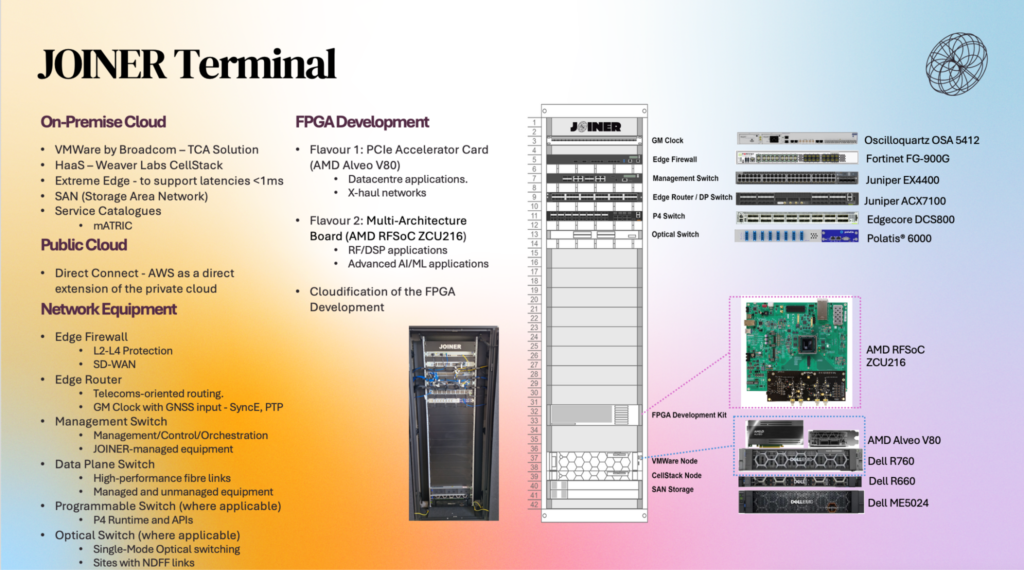
Each of the 15 nodes within the JOINER network houses a full server rack of equipment. These are what we call our Terminals, and we ship one to each of the locations we support. Each rack combines cloud, compute, networking, storage, programmable hardware resources, and a Grandmaster Clock within a common architecture.
Terminal deployments include Dell PowerEdge R760 and R660 servers, NVIDIA L40S GPUs, high-performance SAN storage, programmable networking equipment, and FPGA development platforms such as the AMD Alveo V80 and AMD RFSoC ZCU216. In a handful of cases, such as for those locations at which specific research is being done into RF or cloud, the setup is customised to accommodate the nuances of those projects.
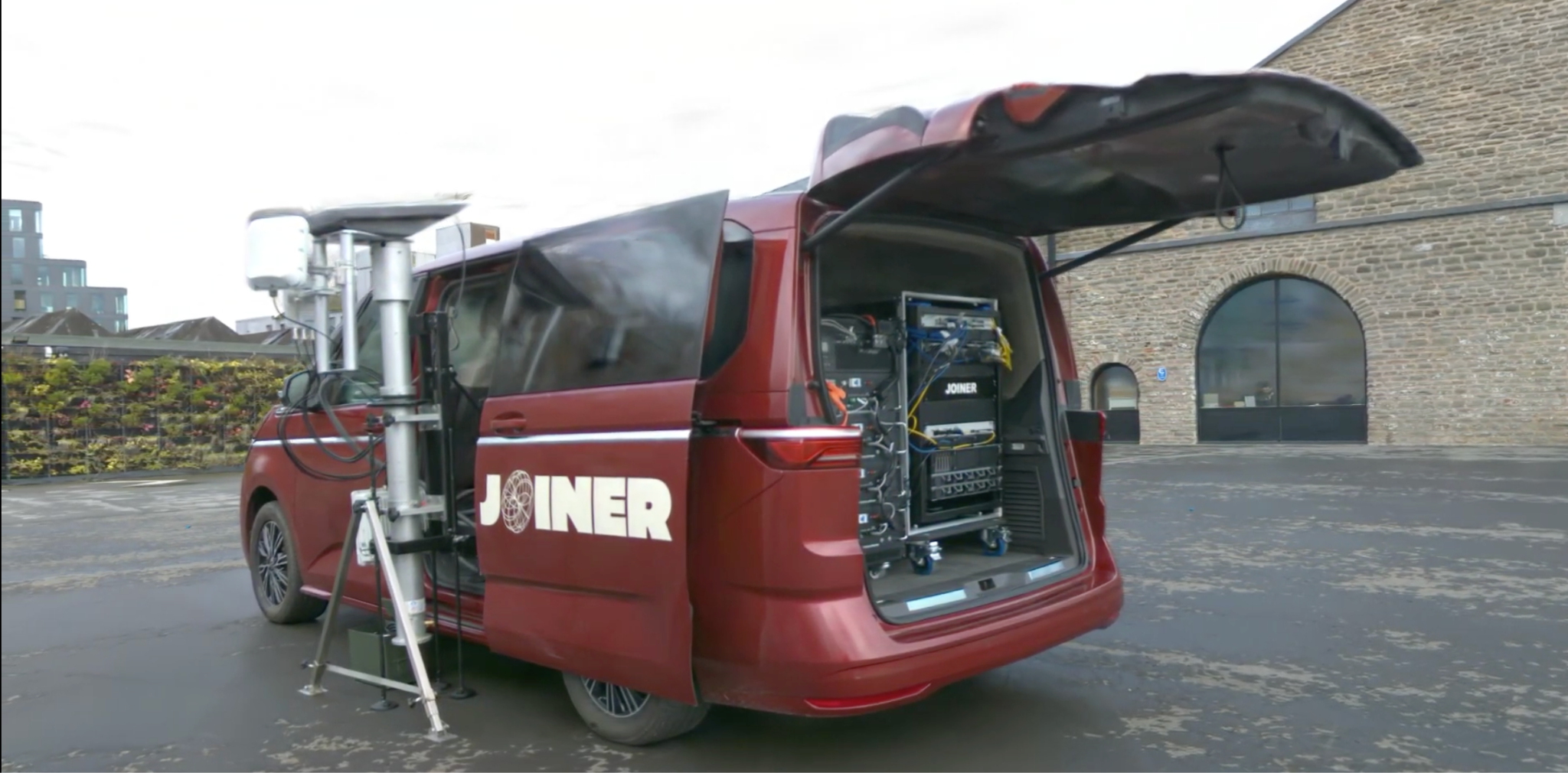
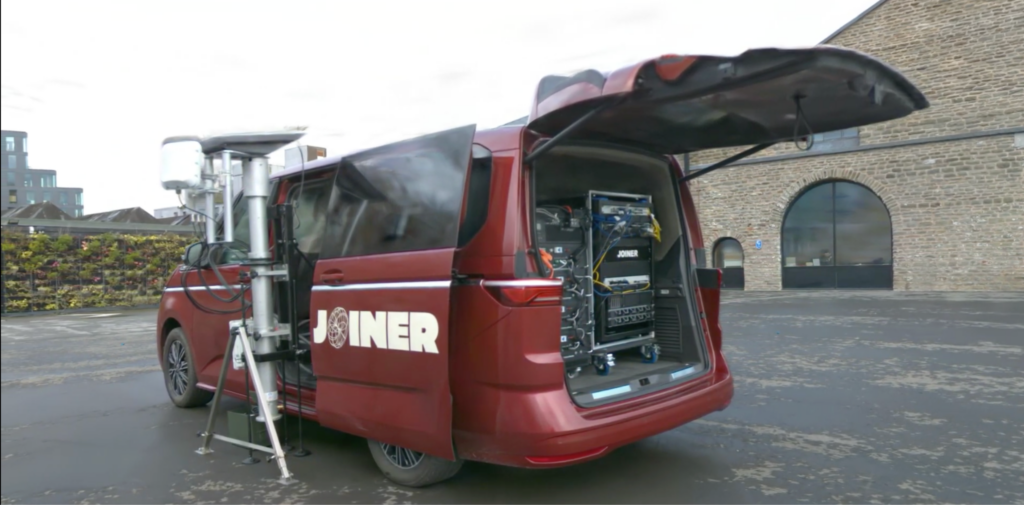
In addition to the 15, in-situ Terminals, we have what we call the JOINERmobile — our nomadic terminal. This is a Volkswagen Mulitvan loaded with much of the same hardware found at our fixed locations, along with a battery pack and inverter that can provide up to five hours of off-grid operation. A telescopic pole hoists a Starlink LEO and a Ruckus WiFi7 access point, which, along with a 5G access point, provides the connectivity required to tie the nomadic node in with the rest of the JOINER network.
Fabric: network infrastructure
The Fabric is the networking backbone that connects all of JOINER’s experimentation resources. It covers anything and everything that goes in-between the different Terminals, so this includes Layer 1 to Layer 3 switches, routers, satellite connectivity, cloud services, and infrastructure management platforms, both physical and virtual. Some of this equipment lives within the Terminal — distributed cloud, multi-access controllers, FPGA development kits — while the rest refers to infrastructure linking the nodes.
Each of the JOINER Terminals have a 10Gbps link coming directly from the Jisc network, which is our national fibre provider. The only exception is the Bristol node, which doubles as JOINER’s operations centre, and boasts a 40Gbps connection, expanding up to 100Gbps if the extra capacity is required.
In addition to this, there are direct terminal-to-terminal links, direct integration with AWS Public Cloud (both through direct connection and site-to-site VPN), the option for dark fibre links between terminals, and backhaul switching via satellite connectivity where required (such as in the case of the mobile node).
The Brain: centralised orchestration and analytics
Sitting on top of all of this, is the Brain.
I wrote briefly about the JOINER Brain last summer. Then, the focus was on explaining what the Brain can do — in particular, the way it simplifies access to the JOINER network and shaves off months of time spent on network design and component procurement in the process.
The Brain is a multi-layered platform orchestrator. Developed and deployed in-house here in Bristol, it sits on top of the other controllers and orchestrators within the wider platform, in order to bring everything together and provide end-to-end, multi-tenancy, service provision.
Users log in via a simple web interface, where they have their own space in which to monitor and manage different projects. From there, they can track measurements and analytics from across the entire platform, and can control and manage their own resources — anything from virtual and physical networking, to cloud, FPGA development, spectrum monitoring, or really anything that’s integrated within the JOINER platform. The multi-tenancy setup, meanwhile, enables different policies and permissions to be assigned to different users, depending on their role within a project. Finally, the Brain is where users will also access the standard suite of IT services, including security tools, remote access, and troubleshooting via the service desk.
Accelerated innovation
In search of a metaphor, I think of the platform as a buffet.
The ingredients have been purchased, prepared, and presented in multiple dishes. It is simply up to the user to fill their plate, and arrange it how they prefer — before tucking in. All the preparation work has been done, you can simply focus on the eating. See how everything tastes.
Or, to bring it back to telecoms terms: procurement is sorted, let’s experiment — and see which innovation works.